Easy mode in Punch It: nine values from x1.28 to x12.78
The gentler of the two settings. Same nine stages, same four figures, and a value path that climbs in even-looking steps to a ceiling of x12.78 instead of making one enormous jump at the end.
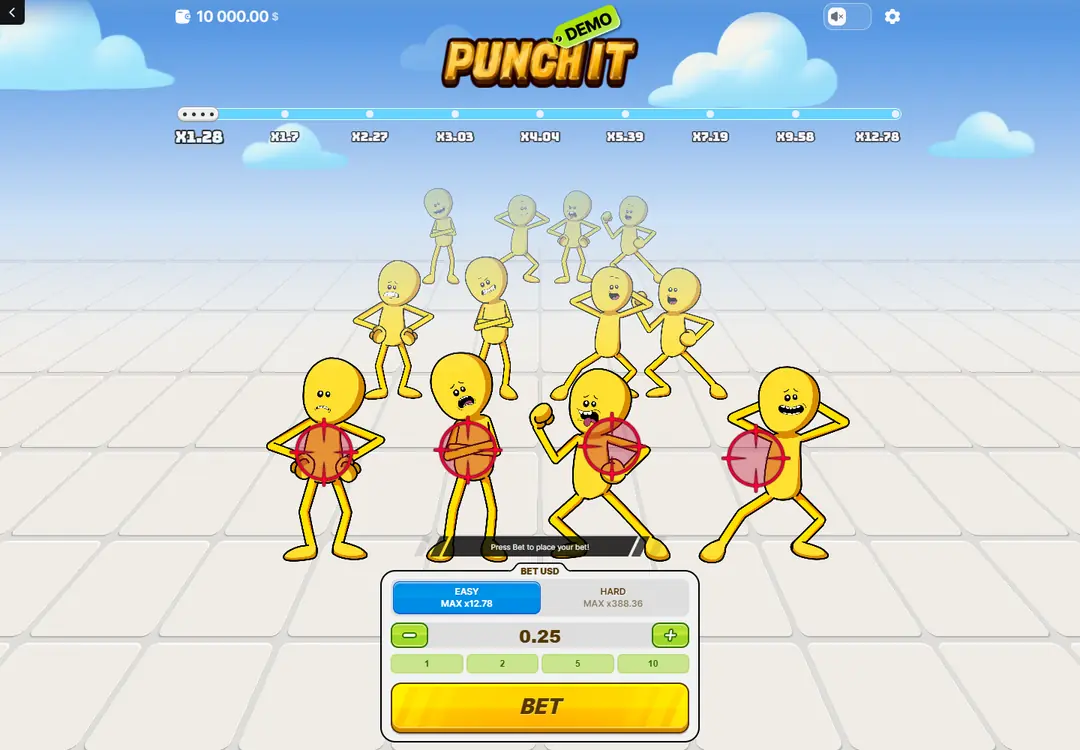
Easy mode. The nine values run along the top before anything is staked, and the four figures in front are the current stage.
The game → Easy
The complete Easy sequence
The Easy tracker carries nine values in one horizontal line: x1.28, x1.70, x2.27, x3.03, x4.04, x5.39, x7.19, x9.58 and x12.78. All nine are visible before a round starts, so the opening and the ceiling can be read together rather than discovered on the way up.
The selected half of the difficulty control repeats the ceiling as MAX x12.78, which is also the ninth value on the tracker. Two places saying the same number is not redundancy here: one of them is the setting you chose and the other is the path you are walking, and seeing them agree is how you know the selector did what you pressed it for.
Each value is roughly a third again on the one before it, all the way along. That is the shape of the whole setting in one sentence, and it is why this path reads as the steady one: no stage is a cliff relative to the one before it.
A steady curve, and what steady does not mean
A path that climbs evenly is easier to read, and it is easy to slide from there into believing it is safer. It is not, in the sense that matters. The share of everything staked that comes back over a long run is a property of the game, not of which setting you chose, and the setting does not hand you a better deal — it hands you a different distribution of results.
What the steady curve really changes is how a session feels. Stages that pay a modest multiple are stages you get past more often, so rounds last longer and end in small amounts more frequently. Many players prefer that, and it is a perfectly good reason to pick this setting. It is not a reason to expect more back.
The flip side is the ceiling. x12.78 is a modest top figure next to the harder setting's x388.36, which is the honest limitation of this path: a run of nine clean stages pays well under thirteen times the stake. If the ceiling is the point of the game for you, the other setting is the one to read, with its own trade-off written out.
Four targets stay in the same place all the way up
Easy keeps four figures in the active row at every one of the nine stages. Red markers identify the live group once a stake is placed, the rows behind it preview the distance still to go, and the tracker above carries the exact value of the position you are on.
That repetition is what makes the stages recognisable. Expressions and poses vary from stage to stage, but the selectable area does not move, and the glove returns to the same foreground position every time. By the third stage of your first round you already know where everything is, which is more than most instant titles manage.
Nothing about the structure changes with height, either. The ninth stage presents four figures exactly as the first one did. The number written under the position is the only thing that has moved.
The first completed stage, in money
After the first successful punch the x1.28 point and the segment leading to it turn green, and x1.70 becomes the position ahead. The state our source records is a 0.25 stake, which the withdraw control displays as 0.32 — the stake multiplied by the first value, after the interface rounds it.
Three things are therefore on screen at once: how far the round has come, what the next decision is, and what the round is worth if you stop now. None of them needs a separate panel and none of them hides the others, which is the single best thing about this layout.
It is also the moment the game is actually asking you something. x1.28 of a stake is a small profit; x1.70 is a slightly larger one with another stage of risk attached. Every later decision in the round is the same question with bigger numbers in it.
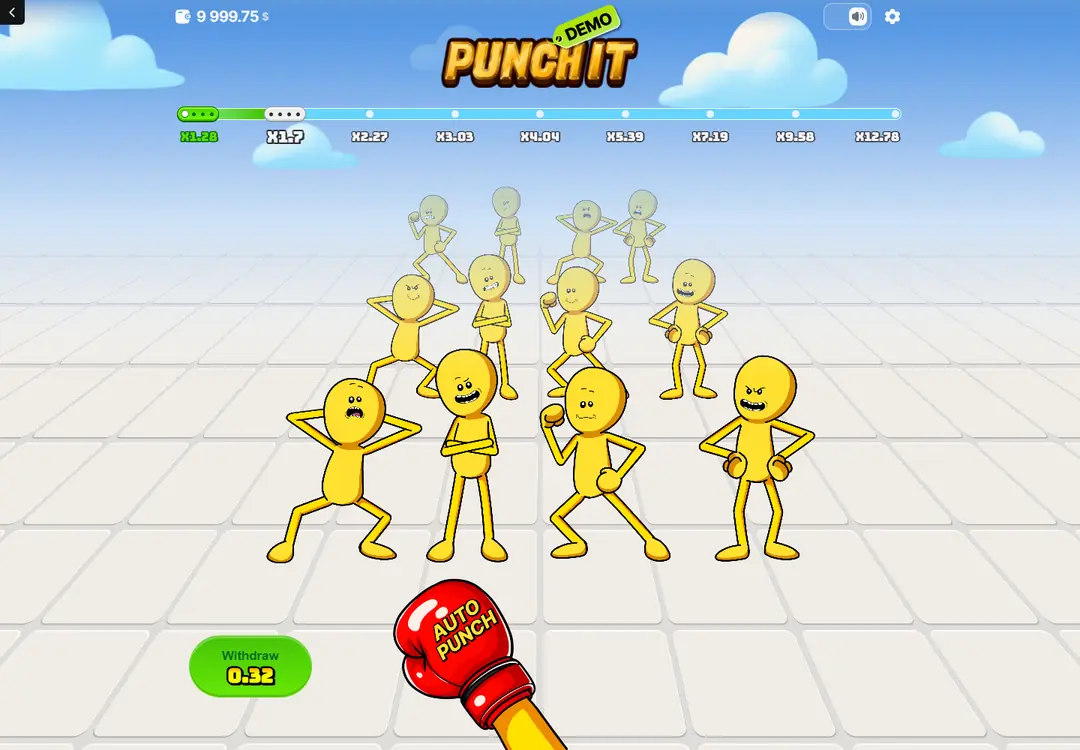
One stage completed. The finished segment turns green, the next group moves forward, and the withdraw control picks up a figure.
Easy mode on a narrow screen
In portrait the two difficulty halves stay side by side, with the selected one highlighted and MAX x12.78 visible inside it. The stake amount, its stepper buttons, the quick values and the start control stack underneath the field of figures.
The tracker stays horizontal and holds the top of the screen. A phone cannot show nine values at a comfortable size at once, so it keeps the current position and its neighbours legible and lets the far end of the path sit tighter. The nine-position identity survives that compression, which is the part that had to.
Everything else is the same game. The portrait layout is covered in full on its own page, including what moves into the safe area on iPhone and what happens to the controls once a stage goes live.
Questions about the gentler path
- What does Easy mode pay at the top?
- x12.78 of the stake, reached by completing all nine Easy stages. The selected half of the difficulty control shows the same figure as MAX x12.78.
- Do the two settings share any values?
- The first four, x1.28 through x3.03, are identical in both. The paths separate at the fifth stage and stay apart to the ninth.
- Is the gentler setting the better-value one?
- No. It changes how often rounds end in a small win rather than how much the game gives back over time. The published values are scaled so neither setting is the bargain.
- How many opponents appear at each stage?
- Four, at every stage of both settings. The count does not rise with the multiplier.
Every value on this page is read from the Easy tracker as the earlier build of this site recorded it, stage by stage. Nothing here is averaged, rounded or inferred from a catalogue entry.
Related pages
The game · A round · Hard · Multipliers · On a phone · Game info