Multipliers in Punch It, stage by stage, and what each one costs
Nine positions, two sets of labels. Four of the positions carry the same number whichever setting you are on, and the other five are where the whole character of the game is decided.
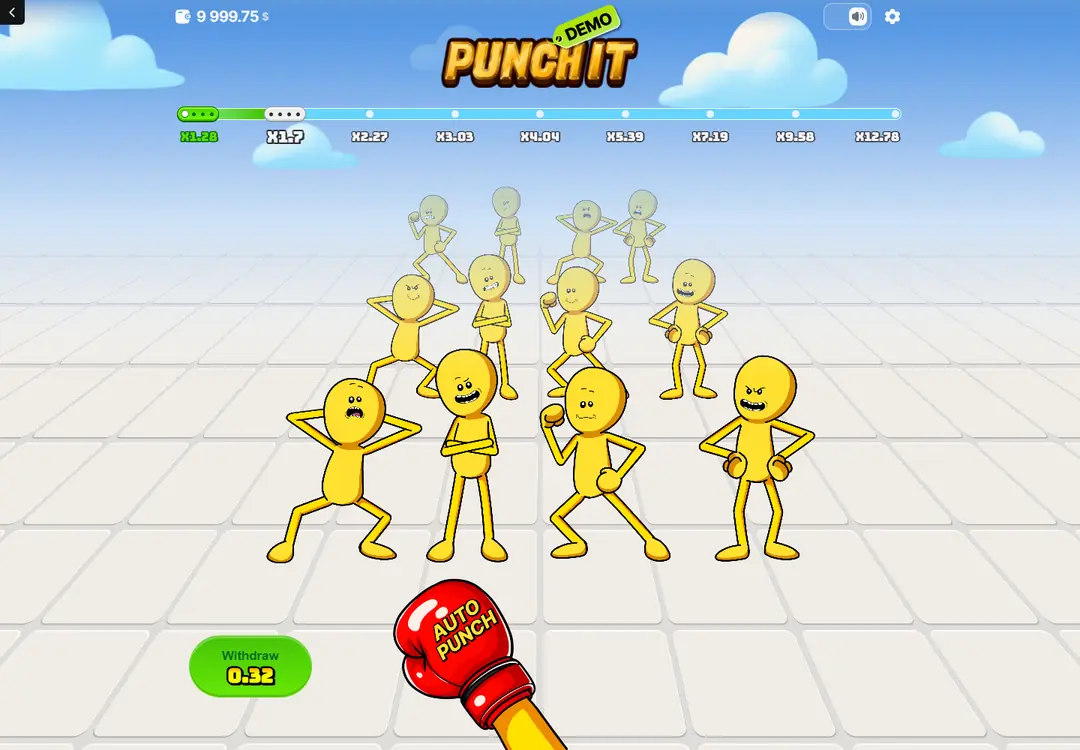
One stage completed. The finished segment turns green, the next group moves forward, and the withdraw control picks up a figure.
The game → Multipliers
Stages one through four are shared
Both settings open x1.28, x1.70, x2.27 and then x3.03 at the fourth position. Switching the difficulty control leaves that opening untouched, which makes the tail of the path the only numerical difference between the two.
The tracker itself is evenly spaced dots with short segments between them and a label under every point. A marker sits before the first stage at the start of a round and completed sections fill in green behind it. The display therefore carries two unrelated kinds of information at once — where you are, and what each place is worth — without letting either stand in for the other.
Reading those first four numbers is worth a moment, because they are the part of the game you will see most often. x1.28 is a 28% profit on the stake; x3.03 roughly triples it. Four stages in, on either setting, the round is worth three times what it cost.
Where the gentler path carries on
From the fifth position the gentler setting shows x4.04, x5.39, x7.19, x9.58 and x12.78. The increments stay close to the ratio the opening established, so the curve never bends: the ninth value is a little over four times the fourth.
MAX x12.78 appears in the selected half of the difficulty control and matches the ninth tracker value. The board length does not change with the setting — no position is added or removed — so the two sequences can be compared position by position rather than as two different games.
That comparability is the useful thing about this layout. The question is never “which game is better”; it is “at this position, what is this setting paying, and what did the other one pay”. The gentler sequence in full is on its own page, with what the shape of it does to a session.
Where the harder path takes over
The harder setting replaces those final five with x6.06, x12.13, x24.27, x97.09 and x388.36. The step from the eighth to the ninth is the largest single jump in the product, and the step before it is not far behind.
Because all nine labels are on screen in the opening state, that tail can be read without entering a round at all. Once a round starts, the same tracker turns into a progress display: finished points go green, the next position waits ahead, and the row of figures changes as the path moves along.
Those last two numbers are also the reason the harder path is a different proposition rather than a bolder version of the same one. The page for that setting works through what the size of them implies, and what there is to weigh against the ceiling.
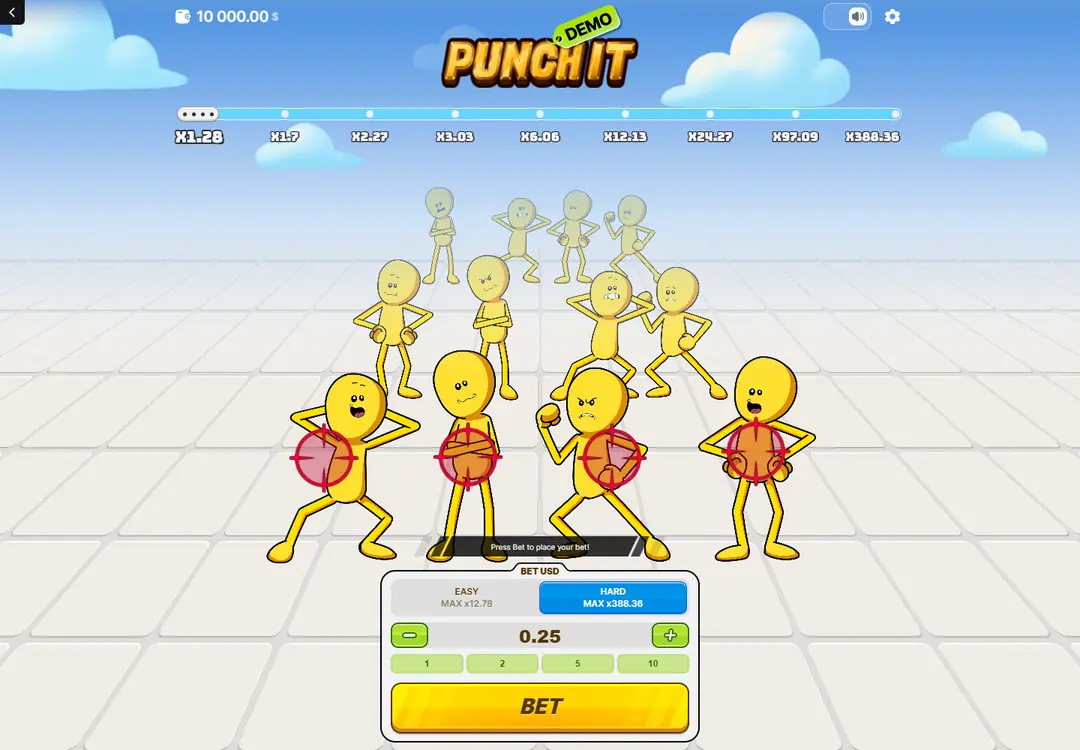
Hard mode. Same nine positions, same four figures, and a different set of numbers written under the last five of them.
What the withdraw figure is actually made of
After a success the control shows money, not a multiplier. It is the stake multiplied by the value of the position reached, after the interface rounds the result. The state our source records is a 0.25 stake on the first position of the gentler path, which displays as 0.32.
Keeping those two numbers apart in your head is the difference between reading the screen and guessing at it. The tracker explains position and factor; the green control states what stopping now is worth. At a 10.00 stake the same first position reads 12.80, and at 150.00 it reads 1,920.00, because the factor never changes with the stake.
Around all of this the game keeps the balance at the top of the screen, the stake in the setup panel, the Live, My and Top information below the arena and access to the verification panel. None of that crowds the four figures, which stay the only thing you act on.
Why a bigger number has to be a rarer one
A published value path is an unusually honest thing for a casino game to have, and it lets a reader check a claim that normally has to be taken on faith. If a game gives back a fixed share of everything staked, then a position paying thirty times what another position pays cannot be reached anything like as often. The numbers are not generous and stingy; they are priced.
That is the whole answer to every system ever written for a game shaped like this one. Stopping at the fourth position and pushing to the ninth are two different distributions of the same long-run return — one with many small wins, one with rare large ones. Neither is a way through the edge, and the edge is what pays for the game existing.
It also disposes of the patterns. The figure you pick at a stage, the colour of the last few rounds in the Live tab, the length of a losing streak: none of it carries information about the next punch. Anything presented as a predictor of a stage is being sold to you, and what is being sold is arithmetic you can already read off the tracker for free.
Questions about the value path
- How many values are shared between the settings?
- Four: x1.28, x1.70, x2.27 and x3.03. Everything from the fifth position onward differs.
- Does the withdraw control show the multiplier?
- No, it shows money: the stake multiplied by the position reached, after the interface rounds it. A 0.25 stake at x1.28 displays as 0.32.
- Can the number of positions change?
- No. Nine in both settings, with the same four figures at each. Only the labels under the last five positions move.
- Is there an optimal position to stop at?
- Not in terms of what comes back over time. Stopping early and pushing on produce different distributions of results from the same underlying return.
Both sequences and the stake example come from the earlier build of this site, which recorded the tracker and the withdraw control state by state. The ceiling also appears, rounded to 388x, in an outside catalogue entry.