Hard mode in Punch It: the climb to x388.36 and where it starts
Nine stages again, four figures again, and the same opening four values. From the fifth stage the numbers stop being polite: the path runs x6.06, x12.13, x24.27, x97.09 and finishes at x388.36.
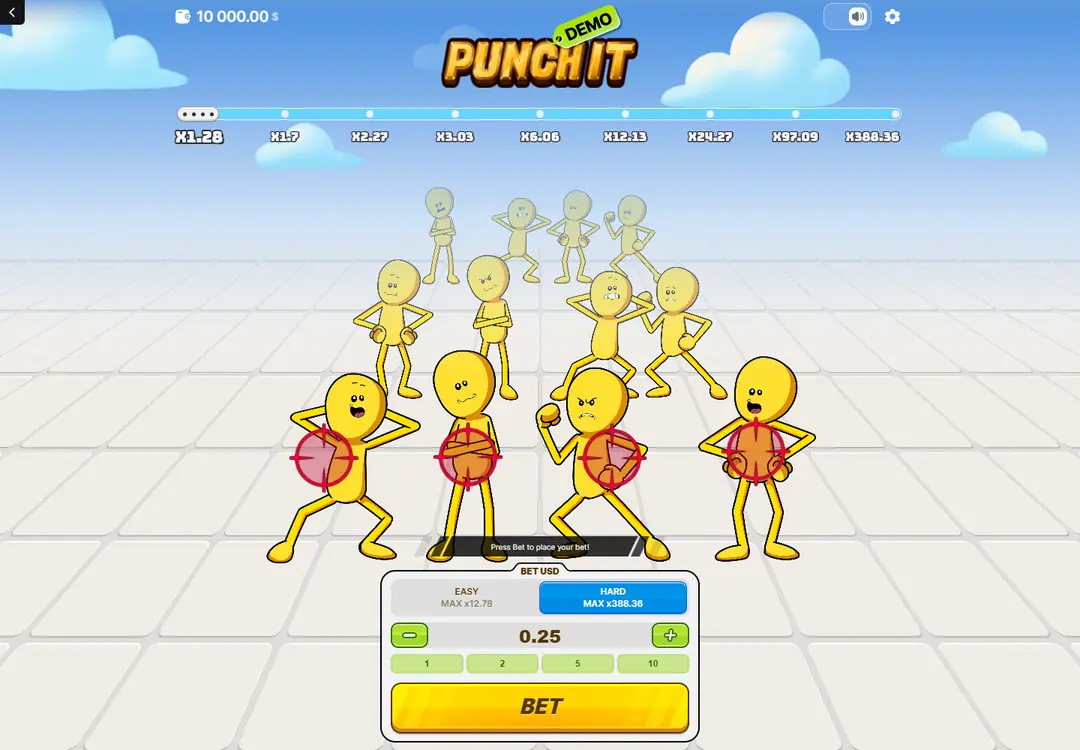
Hard mode. Same nine positions, same four figures, and a different set of numbers written under the last five of them.
The game → Hard
The complete Hard sequence
Hard carries x1.28, x1.70, x2.27, x3.03, x6.06, x12.13, x24.27, x97.09 and x388.36. The first four are shared with the gentler setting, which gives the two paths a common opening; the remaining five are this setting's own and are drawn on the same tracker.
The selected half of the difficulty control states MAX x388.36, and the last tracker value repeats it, so the ceiling can be identified both in the setup panel and at the end of the path. A catalogue entry for the title describes the game as paying up to 388x the bet, which is the same number with the decimals dropped.
The board itself is unchanged. Nine positions, four figures per stage, no extra rows. The difference between the two settings is entirely in the numbers written under the positions — which is a cleaner piece of design than most two-mode games manage, because nothing you learned about the layout has to be relearned.
Stage five is where the two paths part
Up to the fourth stage the two settings are indistinguishable: identical values, identical layout. At the fifth, the gentler path shows x4.04 and this one shows x6.06, and from there they diverge sharply rather than drifting apart.
That shared opening is worth knowing before you switch settings mid-session, because the first four stages of a Hard round look exactly like a gentle one. The arena gives no extra warning at the fifth stage; the only thing that announces the change is the number written under the position, which was readable from the start.
It also means the comparison between the settings is a comparison of five values, not nine. Laid out together, the shared opening and the two tails are easier to hold in the head than either full sequence on its own.
The late-stage curve is visibly steeper
From the seventh stage onward the path stops being a progression and becomes a series of jumps: x24.27, then x97.09, then x388.36. On screen those three positions are spaced like any other three, which is the one genuinely misleading thing about the display — equal spacing for numbers that are nothing like equal.
Read it the other way and it is informative. The tracker separates order from size on purpose: a completed stage always advances one position, and the label underneath says what that position is worth. The spacing is about progress; the label is about money.
The size of those last values is also the clearest statement the game makes about its own odds. A stage cannot pay x388.36 and be a stage you usually get past. The two outside pages that describe how many of the four figures will counter at the final stages put the proportion high, and we give that as their account rather than ours — but the arithmetic of a fixed return says the same thing without needing anyone's account at all.
Strengths and limitations of the harder path
What works: the whole value path is published before a stake is placed, the ceiling is thirty times the gentler setting's, the withdraw control is available after every single success, and nothing about the controls or the layout changes between settings. For a player who wants a long-odds shot with full information about what it pays, that is a well-built version of it.
What to weigh: there is no partial protection anywhere in the round. A counter at the eighth stage takes the whole stake, including everything the first seven stages had built up, exactly as a counter at the first would. The round is all-or-collected at every point, with nothing banked along the way.
And the ceiling is a ceiling, not a target. Reaching x388.36 means nine consecutive stages with the hardest of them at the end. Treating that figure as the point of a session is how a session ends early. The seventh stage with x24.27 showing in the withdraw control is a real result; the ninth is a story.
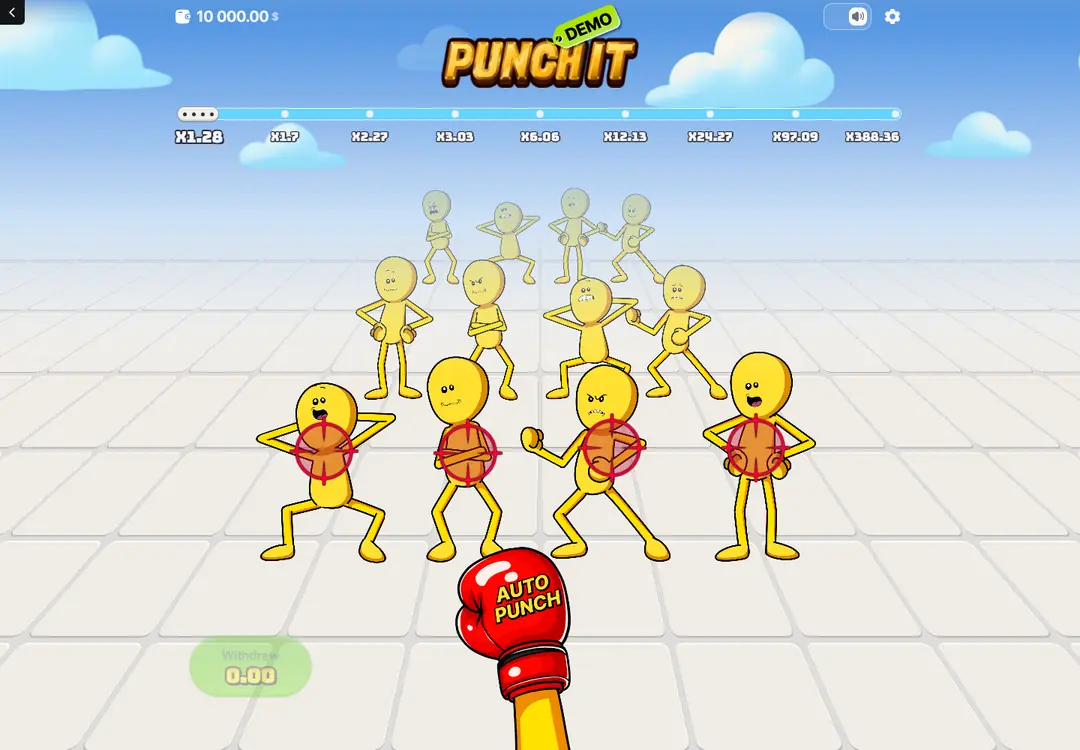
An active stage: four marked figures, and the oversized glove that resolves the stage without choosing one of them.
Same controls, different arithmetic
Once a Hard round is live, four front figures receive markers and the glove appears at the bottom centre, just as in the gentler setting. Manual selection and automatic selection are both available and both do exactly what they do elsewhere. A completed stage turns the tracker segment green and puts a figure in the withdraw control.
So the setting is visible in two places and two places only: the value labels and the selected half of the difficulty control. Nothing about where you tap changes. That consistency is why the harder path is easy to walk into without noticing, and why reading the labels before staking is the only habit worth having here.
On a phone, the harder setting keeps its place beside the gentler one in the compact selector with MAX x388.36 showing, the field of figures takes more vertical room, and the tracker compresses horizontally. The round structure itself is identical on every screen size.
Questions about the harder path
- What is the highest a round can pay?
- x388.36 of the stake, at the ninth Hard stage. A catalogue entry for the title gives the same ceiling as 388x the bet.
- Where do the two settings stop agreeing?
- At the fifth stage. The first four values are identical; the fifth shows x4.04 on the gentler path and x6.06 on this one, and they diverge from there.
- Is any progress kept if a stage is lost?
- No. A counter-punch ends the round and takes the whole stake, whether it happens at the first stage or the eighth. Nothing is banked on the way up.
- Does the harder setting add stages or opponents?
- Neither. Nine positions and four figures per stage, the same as the gentler setting. Only the values written under the last five positions change.
Both sequences on this page are read from the trackers as the earlier build of this site recorded them. Where an outside page is the only thing saying something, this page says so in the sentence that uses it.
Related pages
The game · A round · Easy · Multipliers · On a phone · Game info