Game info for Punch It: studio, return, stage count, bet range
Everything this site is willing to state about the product, with the source of each figure named. Where two sources disagree, both appear; where nothing confirms a figure, it is not here at all.
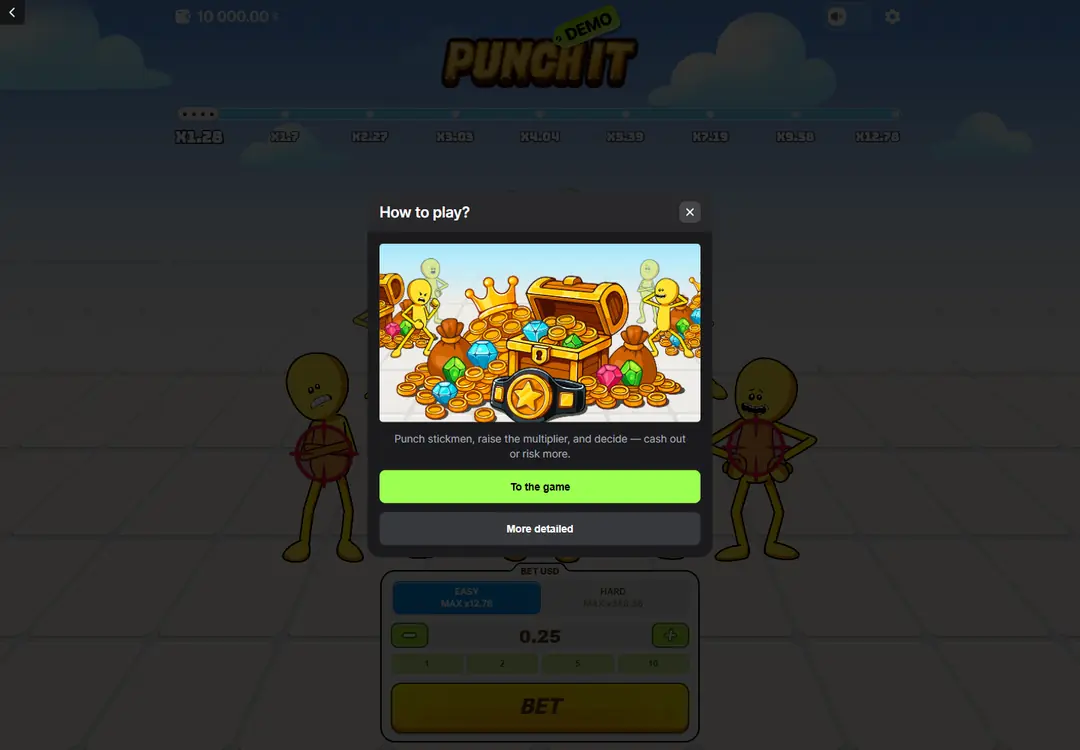
The short information panel the game ships with. Everything on this site that is a figure comes from a panel like this one.
The game → Game info
The core specification
Punch It is an instant step-multiplier game from 100HP Gaming. The board holds nine stages and presents four stickman figures at the active one. The boxing theme is carried by target markers, punch animations, an oversized red glove and a treasure motif at the end of the path, rather than by reels or card symbols.
The stake range our source records runs from 0.10 to 150, without a currency attached to it. The ninth stage pays x12.78 on the gentler setting and x388.36 on the harder one. Both settings use nine tracker positions, share the first four values and separate at the fifth.
The return figure needs two sentences rather than one. Our source lists 96%, read from the game's own information panel, and three outside pages about the title repeat it. One operator's own page for the same game is headed 95%. We have found nothing from the studio that decides between them, so neither is printed here as the figure.
That is not a hole in the specification so much as an accurate description of it. Instant titles are distributed through a platform and a lobby can carry a configuration of the same game, so two honest pages can both be right about different builds. The one that is right about yours is the panel you can open in two taps from the game screen.
Both value sets in one place
The gentler path shows x1.28, x1.70, x2.27, x3.03, x4.04, x5.39, x7.19, x9.58 and x12.78. Its setup panel states MAX x12.78, and the same value sits at the ninth tracker position.
The harder path shows x1.28, x1.70, x2.27, x3.03, x6.06, x12.13, x24.27, x97.09 and x388.36, with MAX x388.36 in the panel and at the final position. The board does not change size between them. An outside catalogue entry gives the ceiling as 388x the bet, which matches our own figure to the decimals it omits.
Those eighteen numbers are the specification of the game in the sense that matters to a player, more so than any single summary figure. Set out side by side, they also show what the difficulty control is really selling: not a bigger game, a differently priced one.
Round controls and progress states
A round begins from the start control once the setting and the amount are chosen. The active stage marks four figures; one can be picked directly, or the glove can resolve the stage automatically. A success turns the completed tracker segment green and moves the active state on one position.
The withdraw control appears with a value after a success and occupies its own area, away from the glove, so the amount available and the control that continues the round can be read independently. The balance stays at the top of the screen and the Live, My and Top tabs sit below the arena.
There is no partial collection and nothing carries between rounds. The figure showing is taken whole or risked whole, which is the entire decision structure and the reason the round is worth reading as a sequence rather than as a spin.
Verification, and what it does and does not prove
The game carries a Provably Fair panel for checking a finished round, alongside sound and settings controls and a short information panel describing the round concept. These sit around the arena without obscuring the tracker state.
What that panel establishes is that a result was not altered after the fact. It is a real and welcome thing to have, and it is routinely stretched into something it is not. It says nothing about how much the game returns over time, and it certainly does not mean a laboratory has certified anything: no laboratory name or certificate number is confirmed anywhere we looked, so none appears here.
The responsive build adapts to portrait and landscape. Phones stack the tracker, the figures and the controls vertically; desktop presents a wider arena with the whole nine-value path visible at once. The values, the four-figure stage and the withdraw logic are identical across sizes.

The artwork the game opens with: a boxer, a glove and the chest that sits at the end of the nine stages.
Where the free-play version stands
A large catalogue publishes a page for this title headed as a free-play page and states on that same page that the demo is unavailable there. One operator's own game page says the title has no demo mode at all. Another operator advertises free play on it.
Read together, that points at an engine which supports a no-stakes mode and operators who enable it or do not. So the accurate answer to “is there a demo” is “sometimes, and it depends where you load it”, which is less satisfying than a yes and considerably more use than a wrong one.
No playable copy of the game exists on this site and none is linked from it. If a no-stakes mode matters to you, the place to find out is the game tile in a lobby you already trust, before any money moves.
What this page does not claim
There is no volatility rating here. Our source does not give one; outside pages call it average, and a one-word rating from a page that is not the studio is not a specification. There is no release date, no certificate, no licence number and no number of lines, because a game of this shape has no lines and the rest is unconfirmed.
There is no bonus figure, wagering term, payment method, withdrawal limit or payout window anywhere on this site either. Those belong to operators, they change without notice, and the cashier a reader is signed in to is always fresher than a page written about it.
And there is no rating of our own. Nothing we hold supports a score, and a star count invented to decorate a page is the kind of claim that costs a site its credibility long before it costs it anything else.
Questions about the specification
- What does a Punch It slot round cost at minimum and maximum?
- From 0.10 to 150 a round, as our source records it. The source does not attach a currency to those numbers, so neither do we.
- Which return figure is correct?
- We cannot settle it. Our source and three outside pages say 96%; one operator's page for the same title says 95%. The panel inside the client you are signed in to is the one that applies.
- What does the Provably Fair panel prove?
- That a finished round was not altered afterwards. It is not a statement about how much the game returns, and it is not a laboratory certificate.
- Why is there no volatility figure?
- Because our source does not carry one and the outside pages that do are not the studio. The published value paths say more about how the game behaves than any single word would.
- Can a real-money bet on the Punch It slot be placed here?
- No. It holds no balance, takes no deposit and asks for no card details or passwords. The button at the top of each page goes to an operator's own site in a new tab.
Every figure above is either read from the game's own panels as the earlier build of this site recorded them, or attributed in the sentence that uses it. Nothing is averaged between disagreeing sources.
Related pages
The game · A round · Easy · Hard · Multipliers · On a phone